Guest Blogger Bob Metcalfe: Metcalfe’s Law Recurses Down the Long Tail of Social Networks
August 18, 2006
vcmike
The blogosphere has started bubbling some interesting discussion of how Metcalfe’s Law applies to current Web 2.0 dynamics like social networking. Some IEEE types, Brad Feld, Niel Robertson, a PhD. student named Fred Stutzman, my partner Sim Simeonov, myself and a few others have posted on this in the last few weeks.
Bob Metcalfe, who invented the law in the first place and is my partner at Polaris (and who, along with Al Gore, invented the Internet…), offers his own view in a guest blog post below.
Metcalfe’s original insight was that the value of a communications network grows (exponentially, as it turns out) as the number of users grows.
All seem to agree that Metcalfe’s Law offers a good theoretical framework for thinking about Social Networks. Robertson argues that in addition to the number of users, the rank of a social network is another variable that should be considered when the law is applied to a social network as opposed to a communications network; Stutzman, on the other hand, suggests that one ought to add consideration of “the sum of actions and associations” enabled by a particular social network.
Not surprisingly, Metcalfe himself offers a more insightful and, I think, important contribution to the conversation — that to understand the value of a social network we need to consider not just the number of users but also the affinity between the members of the network.
Enjoy Bob’s post, and by all means please feel free to add your own comments…
Metcalfe’s Law Recurses Down the Long Tail of Social Networking
By Bob Metcalfe
Metcalfe’s Law is under attack again. This latest attack argues that the value of a network does not grow as the square of its number of users, V~N^2, like I’ve been saying for 26 years, but slower, V~N*Log(N). The new attack comes in a cover story by Briscoe, Odlyzko, and Tilly in a prestigious 385,000-member social network called IEEE SPECTRUM. And now they are saying that my law is not just wrong but also “dangerous.”
Below is the original not PowerPoint but 35mm slide I used circa 1980 to convince early Ethernet adopters to try LANs large enough to exhibit network effects – networks larger than some “critical mass.”
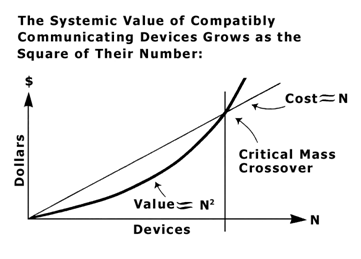
This slide was named “Metcalfe’s Law” by George Gilder in the September 1993 issue of FORBES and later in his book TELECOSM. Again, thank you, George.
Ethernet’s early adopters took this advice, and so my computer communication compatibility company, 3Com, prospered. Last year, according to IDC, 33 years after Ethernet’s invention at Xerox Parc, a quarter billion new Ethernet switch ports were shipped worldwide.
And now for some inconvenient truths. Al Gore famously claimed to have invented the Internet in the 1980s, which struck some of us as a little late. Like his father, Al Gore Senior, who claimed to have invented what is inexplicably called the Eisenhower Interstate Highway System, Al Gore Junior invented what he called the Information Superhighway. The actual Internet was invented, I think, either by BBN at UCLA in 1969 or at Stanford in 1973.
With his Information Superhighway, Gore invented not the Internet but the Internet … Bubble. I was present when Vice President Gore mentioned Metcalfe’s Law in an MIT commencement address, inflating his administration’s Internet Bubble. I helped Gore inflate the Internet Bubble by touting Metcalfe’s Law. I am not sorry.
There are people who think the Internet Bubble was the worst thing that ever happened, and I hope those people are satisfied now that Ken Lay is dead. To those people my law may be, as the SPECTRUM article says, dangerous. Because my law allegedly over-estimates the values of networks, it might be used to inflate a second Internet Bubble, probably the imminent Social Networking Bubble, which will then inevitably burst. Can’t have that.
So, in IEEE SPECTRUM, Briscoe, Odlyzko, and Tilly debunk Metcalfe’s Law, again. It turns out that the value of a network does not grow as the square of the number of its users, V~N^2, but much more slowly, V~N*log(N), they figure. Cold water can now be thrown on the promoters of social networking. The bursting of a second Internet Bubble is thereby averted.
In renewed defense of Metcalfe’s Law, let me first point out that Al Gore has moved on to the invention of Global Warming. If a second Internet Bubble is to be inflated, I will have to do it without Gore’s hot air this time… Let’s get started.
Let me contrast Metcalfe’s Law with
Moore’s Law. Moore’s and Metcalfe’s Laws are similar in that both begin with the letter M. They are different in that
Moore’s Law is exponential in time while Metcalfe’s Law is quadratic in size.
Moore‘s Law, which states that semiconductors double in complexity every two years, has been numerically accurate since 1965. Metcalfe’s Law, on the other hand, has never been evaluated numerically, certainly not by me.
Nobody, including Briscoe, Odlyzko, and Tilly in their SPECTRUM attack, has attempted to estimate what I hereby call A, network value’s constant of proportionality in my law, V=A*N^2. Nor has anyone tried to fit any resulting curve to actual network sizes and values.
As I wrote a decade ago, Metcalfe’s Law is a vision thing. It is applicable mostly to smaller networks approaching “critical mass.” And it is undone numerically by the difficulty in quantifying concepts like “connected” and “value.”
So, if the value of a network does grow as V~N*log(N), I challenge Briscoe, Odlyzko, and Tilly to prove it with some real network sizes and values. In the meantime, I’ll stick with V~N^2.
While they’re at it, my law’s critics should look at whether the value of a network actually starts going down after some size. Who hasn’t received way too much email or way too many hits from a Google search? There may be diseconomies of network scale that eventually drive values down with increasing size. So, if V=A*N^2, it could be that A (for “affinity,” value per connection) is also a function of N and heads down after some network size, overwhelming N^2. Somebody should look at that and take another crack at my poor old law.
But, if anybody wants to spend time on Metcalfe’s Law, let me suggest what are likely to be more fruitful paths. Accurate formulas for the static value of a network are fine, but it would be much more useful to understand the dynamics of network value over time. Also important would be linking Metcalfe’s Law to
Moore’s Law and showing how that potent combination underlies what WIRED’s Editor-in-Chief Chris Anderson calls The Long Tail.
Metcalfe’s Law points to a critical mass of connectivity after which the benefits of a network grow larger than its costs. The number of users at which this critical mass is achieved can be calculated by solving C*N=A*N^2, where C is the cost per connection and A is the value per connection. The N at which critical mass is achieved is N=C/A. It is not much of a surprise that the lower the cost per connection, C, the lower the critical mass number of users, N. And the higher the value per connection, A, the lower the critical mass number of users, N.
Continuing to paint with a broad brush, I take
Moore’s Law to mean that my law’s connectivity cost C — the cost of the computing and communication used to create connectivity — is halved every two years. Combining Moore’s and Metcalfe’s Laws, therefore, the number of users at which a network’s value exceeds its cost halves every two years. And that’s just considering C.
I am reminded that the first Ethernet card I sold at 3Com in 1980 went for $5,000. By 1982, the cost was down to $1,000. Today, Ethernet connections cost under $100, perhaps as low as $5 per connection. Whatever the critical mass sizes of Ethernets were in 1980, they are a lot lower now.
But that’s not all. The denominator of C/A, the constant of value proportionality, A, has been going up. In the 1980s, Ethernet connectivity allowed users only to share printers, share disks, and exchange emails — a very low A indeed. But today, Internet connectivity brings users the World Wide Web, Amazon, eBay, Google, iTunes, blogs, … and social networking. The Internet’s value per connection, A, is a lot higher now, which means the critical mass size of the Internet, C/A, is a lot lower now, and for two reasons: cost and value.
Amazon connectivity among people and books allows my five-year-old book, INTERNET COLLAPSES, to be available still, with Amazon rank below 1,000,000. There’s eBay connectivity among people with ever more arcane things to buy and sell. There’s blogosphere connectivity among many more writers each with many fewer readers. Daily newspaper circulations have been going down since 1984, and there are now millions of active blogs, most of them very small. Blogs are an early form of social networking among growing numbers of smaller groups along ever more refined dimensions of affinity.
Social networks form around what might be called affinities. For each affinity, there is a critical mass size given by N=C/A, as above. If the number of people sharing an affinity is above this critical mass, then their social network may form, otherwise not. As Internet access gets cheaper and the tools for exploiting affinities get better, many more social networks will become viable.
Somebody should look at this. Somebody already has: Chris Anderson.
Moore’s and Metcalfe’s Laws bring us to Chris Anderson’s new book, THE LONG TAIL, which you should read immediately. (Actually, there’s no rush.
Anderson’s book currently has double-digit rank at Amazon, like my book did five years ago. Take your time and you might even get THE LONG TAIL for next to nothing as it moves down Amazon’s Long Tail.)
Anderson‘s Long Tail explains how, for example, more people are listening to music other than the Top 40 hits. Thanks to iTunes, even though there still is a Top 40, the fraction of music listening from down music’s Long Tail is increasing. It remains to be seen whether the growth of music’s Long Tail increases total music sales, which would be my guess, or whether it shifts revenues away from Britney Spears.
For another example of The Long Tail, millions of books like mine, which would otherwise be out of print, can still be found at Amazon.com and delivered in a day or two. Try buying INTERNET COLLAPSES, used if you must.
Let me leave as an exercise for the reader to develop the formulas for how Amazon’s Long Tail grows to the right as the combination of Moore’s and Metcalfe’s Laws biennially halves the critical-mass size of book audiences. Book buying generally shrinks with time, but I’m guessing that Amazon’s per book critical masses, its N=C/As, have been shrinking faster.
Similar formulas could quantify how Moore’s and Metcalfe’s Laws have also driven down the critical mass sizes (N=C/A) of Internet-enabled social networks and extended their Long Tail to the right. Looking more closely, I see that Metcalfe’s Law recurses. Just being on the Internet has some increasing value that may be described by my law. But then there’s the value of being in a particular social network through the Internet. It’s V~N^2 all over again. Down a level, N is now the number of people in a particular social network, which has its own C, A, V, and critical mass N.
Of course the cost (C*N) of getting connected in a social network has been going down thanks to the proliferation of the Internet and its decreasing price. The value (A*N^2) of particular social networks has been growing with broadband and mobile Internet access. Emerging software tools expedite the viral growth and ease of communication among network members, also boosting the value of underlying connectivity.
So, if you want to spend time on V~N^2, and I hope you do, then forget minor refinements like V~N*log(N) and help inflate the next Internet Bubble by figuring out how Metcalfe’s Law recurses down The Long Tail of social networking.
Bob Metcalfe received the National Medal of Technology from President Bush in 2005 for his leadership in the invention, standardization, and commercialization of Ethernet. Bob is a general partner of Polaris Venture Partners, where he serves on the boards of Polaris-back companies including Ember, GreenFuel, Infinite Power Solutions, Mintera, Narad, Paratek Microwave, and SiCortex.
157 Comments
Post a commentTrackbacks & Pingbacks
- Om and Niall PodSessions
- GigaOM » Blog Archive » Is Metcalfe’s Law Really Wrong?
- SiliconBeat
- The Real Paul Jones » Stutzman v Metcalfe
- Abstract Dynamics
- VC Headlines
- Yoick - Hightechwire » Blog Archive » Affinity: Metcalfe’s Law 2.0
- Blogs are like opinions. Everybody has one… » Blog Archive » Metcalfe’s Law
- HighContrast » Bob Metcalfe Responds to IEEE
- BuzzMachine » Blog Archive » Looking through the wrong end of the wire
- The power of the network at twopointouch: web 2.0, blogs and social media
- n.sputnik/Nick Dynice » Blog Archive » Metcalfe’s Law 2.0 is Web 2.0
- Photo Matt » Metcalfe’s Law and Social Networks
- Matt: Metcalfe’s Law and Social Networks at SocialCode
- Blogocentricity » Reading
- Guest Blogger Bob Metcalfe: Metcalfe’s Law Recurses » technobabble.tv
- Akkam’s Razor
- Fudeblog by Cesar Cardoso » A rede é o…
- Does the Math behind Network value matter? « Honorarium on Tuesday
- What is the Value of a Network? « PurpleSlog
- Living on the Edge » Blog Archive Missing a point or two about models/law «
- Reinventing the Internet » Ethernet - a modest technology gone bad
- AG's Blog
- Hitchhiker’s Guide to 650 :: NMetcalfe’s Law Redux: Why Web 1.0 Giants Are Screwed and Web 2,0 StartUps Saved :: October :: 2006
- the ||doublebar|| » Blog Archive » Metcalfe’s law - update
- Zach Mortensen -- The Economics of Healthcare Information Technology
- why we should poach animals
- SpaceSpace » Craigslist Meets the Capitalists — (Their Head A Splode!)
- baby bedding
- Quality Indonesian Blogger » Blog Archive » n² & n•log(n)
- diamond rings
- TV Sets
- Cornelia Davis’ Weblog » Blog Archive » The power of participation (Collaboration 2.0, Reed’s Law and Metcalfe’s Law)
- Loans
- Relationship Books
- וובסטר 2 - חנן כהן » ארכיון הבלוג » מטקאלף מגן על חוק מטקאלף
- Cisco/Tribe, Ning, Reuters: Social Nets Everywhere! « VCMike’s Blog
- Mark Greenfield - Higher Education Web Consulting » Social Networks and the Long Tail
- ลานซักล้าง » ถอดบทเรียนเกี่ยวกับชุมชนออนไลน์ (ตอนที่ 2)
- Beckstrom’s Law: FAIL « Blogs are like opinions. Everybody has one…
- More info here
- Guest Blogger Bob Metcalfe: Metcalfe’s Law Recurses Down the Long Tail of Social Networks « VCMike’s Blog » Social Marketing
- The Law of Linked Data » AI3:::Adaptive Information
- “The Internet, the Perpetual Beta, and the State: The Long View of the New Medium” « Assorted Materials: Johnny Ryan
- How Metcalfe’s Law explains the attitude of your sysadmin (or what you perceive as negative behavior) « Blogs are like opinions. Everybody has one…
- When Push Needs a Shove: Making Metcalfe’s Law Work for Your Social Venture | Atomic Tango
- The amazing doubling power of social networks « RipMedia Group
- The Quantum Archivist » Metcalfe’s Law and the Information Universe. Or: Why We Should be as Connected as Possible
- Metcalfe’s Law and the Information Universe, Or: Why We Should be as Connected as Possible « The Quantum Archivist
- The long tale of web 2.0 economics « excapite
- Henry David Thoreau On Google Plus « An Associate's Mind
- The amazing doubling power of social networks | RIP MEDIA GROUP
- Metcalfe’s Law: Manifest Destiny of Cerner and Epic? « Zach Mortensen
- Metcalfe’s law – Wikipedia, the free encyclopedia | WorldWright's …
- Find Answers through Your Social Network | Emerson Process Experts
- Metcalfe’s Law Redux: Why Web 1.0 Giants Are Screwed and Web 2,0 StartUps Saved | Nosejob
- On our way to a networked society. | Aide-Memoire
- Metcalfe’s Law Redux: Why Web 1.0 Giants Are Screwed and Web 2,0 StartUps Saved | Hitchhiker's Guide to 605
- Metcalfe’s Law Redux: Why Web 1.0 Giants Are Screwed and Web 2,0 StartUps Saved | Hitchhiker's Guide to 650
- Monetizing the Social Effect: Part 3 | DayOnBay
- Internet Time Alliance | CLO Maths–Part I
- Chapter 3 (part 1) The Network | Viralnomics
- Internet Of Things » Why peer-to-peer doesn’t mean equal
- Metcalfe’s Law in Transit Planning
- When Push Needs a Shove: How To Make Your Network Go Social Already | Atomic Tango
- Long Tail Student Discount Coupon Code
- Long Tail Cheap Deals
- Long Tail Student Discount March
- Long Tail Student Discount 2018
- Long Tail Member Coupons March
- Long Tail Student Discount Coupon Code March
- Long Tail Consumer Coupon Code March 2018
- Long Tail Student Discount March 2018
- Long Tail Consumer Coupon Code March
- Long Tail Student Discount Coupon Code 2018
- Long Tail Cheap Deals March 2018
- Long Tail Offers March
- Long Tail Offers For Students March 2018
- Long Tail Cheap Deals March
- Long Tail Cheap Monthly Deals 2018
- Long Tail Cheap Monthly Deals March 2018
- Long Tail Offers 2018
- Long Tail Offers Online March
- Long Tail Offers Online 2018
- Long Tail Cheap Monthly Deals March
- Long Tail Offers March 2018
- Long Tail Offers For Students 2018
- Long Tail Offers Online March 2018
- Long Tail Offers Today 2018
- Long Tail Coupons Labor Day
- Long Tail Coupons Labor Day March
- Long Tail Coupons Labor Day 2018
- discount long tail pro keyword research | Newest codes around
- offers long tail pro | Newest codes around
- Long Tail Coupons Labor Day 🥇
- Long Tail Coupons Labor Day March 2018 🥇
- Offers Long Tail
- Long Tail Cheaper Alternative
- Offers Long Tail Pro Ultimate Niche Finder
- When Push Needs a Shove: How To Make Your Network Go Social Already – Atomic Tango
- The NFX Archives: Foundations for Mastering Network Effects - NFX
- On our way to a networked society. – Aide Mémoire
- What meerkats could teach a troubled Uber- Vigour Times
- What meerkats could teach a troubled Uber- webtoday.us
- What meerkats could teach a troubled Uber - Elite News
- What meerkats could teach a troubled Uber - Megatrend Investments
- What meerkats could teach a troubled Uber - News07trends
- What meerkats could teach a troubled Uber - Wrapspots
- What meerkats could teach a troubled Uber | The New York Ledger
- What meerkats could teach a troubled Uber - Daily Dunia News | Urdu News | Urdu Khabrain
- What meerkats could teach a troubled Uber - swiftheadline
- What meerkats could teach a troubled Uber - Gur Times


 VCMike's Blog
Mike,
n-squared is not the same as exponential (10 to the n power). Do a quick spreadsheet and you’ll see what I’m talking about.
Dave–thanks for the catch. In case you couldn’t tell I am not exactly the “quant guy” in our shop. My partner Sim Simeonov, on the other hand, was the Bulgarian National Math Champion (this actually is true), so I’ll leave future math blogging to him!
why do people (even smart ones like VCMike and Metcalf) continue to perpetuate this myth about Gore saying he invented the internet? Gore never said such a thing.
http://www.snopes.com/quotes/internet.asp
It is also possible that Zynga’s chosen advertising network is to blame if we consider the case of the New York Times’ website ekeabedbaaed
Oh how I love social networking. If it wasn’t for such a thing I wouldn’t have a job.
Metcalfe’s Law in my opinion is right when we see from a macro view, see the value of the whole network.
The “square” is just like the E=mc^2, which implies the “acceleration” or “self-repeating” nature of this universe.
I think the attack is not as solid as claimed by the attackers.
PurpleRain
http://www.g-economy.com
> There are people who think the Internet Bubble was the worst thing that ever happened, and I hope those people are satisfied now that Ken Lay is dead.
What a cheap shot, Bob.
Unworthy of a man of your distinction and intellect.
Dear customer,
we are mobile phones/laptops/ipods wholesalers, we deals on all
brands and models of mobile phones/laptops.very good prices.
we have mobile phones accessories such as
battery,charger,keypad,housing,datacable,lcd and
laptops.we supply many other electronic products, such
as portable DVD, car dvd,mp3,mp4,lcd TV, plasma tv,cd
rom,dvd writer, windows xp,office 2003 software,ip
phone, USB phone, Bluetooth earphone, Bluetooth USB
dongle,etc.
condition: brand new wireless standard with 1 year
manufacturer warranty and 6 months seller
gaurranty,with original mother board, original English
British battery, all software and manual contain
writing English languages, the shipment will be
delivered via 48 hours over night express drop
shipment to your door step.
We send price list to interested buyers only.
REPLY TO:communicationsukltdl@myway.com.
CALL:+447011132340
Yours faithfully,
WILFRED BAXTER
Metcalfe’s response lost credibility right from the start. Gore never claimed to have invented the internet. He claimed, truthfully, to have taken the initiative in funding its development. Perhaps another law is at work here, i.e. that a statement, true or not, gains credibility in proportion to the number of times it is heard. I’d suggest proportional to log(n), or perhaps sqrt(n).
car
Wow!!! Good job. Could I take some of yours triks to build my own site?
Greetings!..
I did some number-digging to see if Metcalfe’s Law was numerically accurate. Click on my name to see details…
Hi
Further to the obvious advantages that ProCalisX brings to you is the added advantage of a very affordable price epimedium sagittatum
thank you very much
t8oG5MONSBK7j
Bob, you make a very interesting point here…
“my law’s critics should look at whether the value of a network actually starts going down after some size. Who hasn’t received way too much email or way too many hits from a Google search? There may be diseconomies of network scale that eventually drive values down with increasing size.”
un4BlX hi! how you doin?
569 ðåöåïò ïðèãîòîâëåíèÿ îãíåóïîðíîé çàìàçêè áåñïëàòíûå âèäåîêëèïû îðàëüíûé ñåêñ àíàëèç ñèõîâîðåíèÿ ó ìîðÿ íî÷üþ áàëüìîíä àíàëèç õîðîâûõ ïðîèçâåäåíèé àíàëèç ñòèõîâ ïóøêèíà à.ñ. îëþáâè
thank you very much
продам Форд-Фокус 2008 года за 200 тр. торг возможет. срочно!!!
+7 960 200 9209
Very nice post, thanks man!
Is the value of a network actually starts going down after some size? I think so but the question is how long it will take before the fall starts. If the period between the peak and the fall is long enough then I see no worry!
http://www.orderyang.com
I have always enjoyed using both Metcalf’s law and Moore’s law in business plans. They don’t have to be exactly precisely correct to have relevance. What Moore first described was a way for people to visualize the impact of adding Internet users. Perhaps billions of dollars of venture capital would not have been invested in companies had those VCs not believed in Metcalf.
As for the comparison to Web 2.0, I believe that there is a metaphoric relationship to social networks just as there was to Ethernet connections to a network. The difference is that with social networks the quality of the connection must enter into the calculation of the network’s value.
Sam Thacker
visit us!
newsbox.cc
newsbox.us
nbstatus.wordpress.com
NOW!
The Potts lawyer, attorneys, law and legal research information. Find Medical Malpractice resources and locate an attorney.
Классные мультфильмы бесплатно на Кинозоуне.
DJ Tiesto на Pattaya International Music Festival
If you could confront anyone from your past, who would it be and why?
As a Metcalf and an ex 3Comer who has implemented a huge wan over a vpn including “remote” Islands of the UK using UNIX and OS/2 pre year 2000 using 3Com ethernet adapters, bridges, switches, hubs etc. I can vouch for the technology and 100% reliability. As to the value of a network or it’s connections etc. surely once the initial capital is laid out and the running costs are affordable the use to which the connection is made is the value.
Money is not the issue, Bob Metcalfe has made plenty I guess and earnt every Cent too..if you can prove him wrong I’m sure he’ll agree with your proof…I’m going to have a crack at his suggestion for improving understanding of his law and progressing it as he suggested.
Metcalf(e)’s Rule 😉
Thank you for your good article. I know new things, because on this blog.
бесплатное порно видео
thanks you for article
de ce nu:)
Zealous brother, what you sleep, I specify a subject and a sense of comfort not competent to get it, you give me the right who is the main response. Thank you very much different
Служба знакомств «Elmi» – это большая база данных по всем городам Севера Израиля, персональный подход, огромный опыт и внимание. Мы предложим ту форму обслуживания, которая подойдёт именно Вам. Для нас важно, чтобы Вы чувствовали себя уверенно и комфортно. Мы поможем Вам найти своё семейное счастье
Мы работаем в Хайфе, Краёт, Нетании и других городах севера страны.
I do not even know how I finished up here, however I believed this put up was good. I don’t understand who you are however definitely you are going to a well-known blogger for those who aren’t already. Cheers!
Reblogged this on Wikipedia Aficionado – No veo, no oigo, no hablo..
Have you had the experience of looking for a car
only to end up feeling frustrated and overwhelmed by the process?
It may be just be the case that you need some solid advice beforehand.
The information included here can simplify the entire process of purchasing a car.
Simply desired to point out I’m thrilled that i came in your internet page.
Netflix Unblocking for Expats: https://www.intl-alliance.com/store